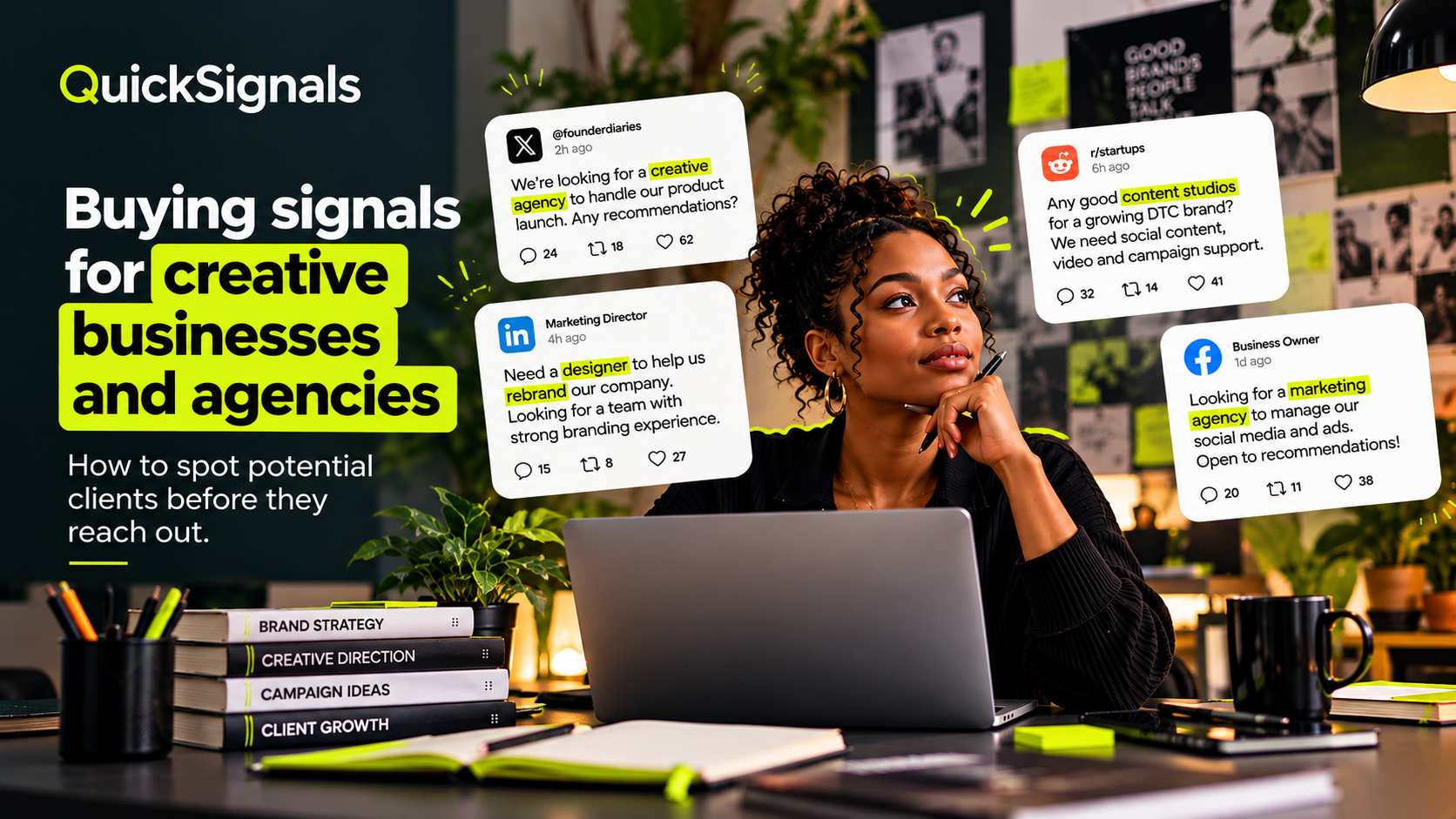
For creative businesses and agencies, a potential client does not always begin with a brief.
Sometimes, the first sign of a potential project is a question posted online. A business may be asking for a designer, looking for help with a rebrand, searching for a marketing partner, or trying to find a creative team for an upcoming launch.
These conversations can offer useful clues about what businesses are looking for.
The challenge is knowing which conversations are simply discussions and which may indicate a genuine need.
Your Next Client May Already Be Talking About the Problem
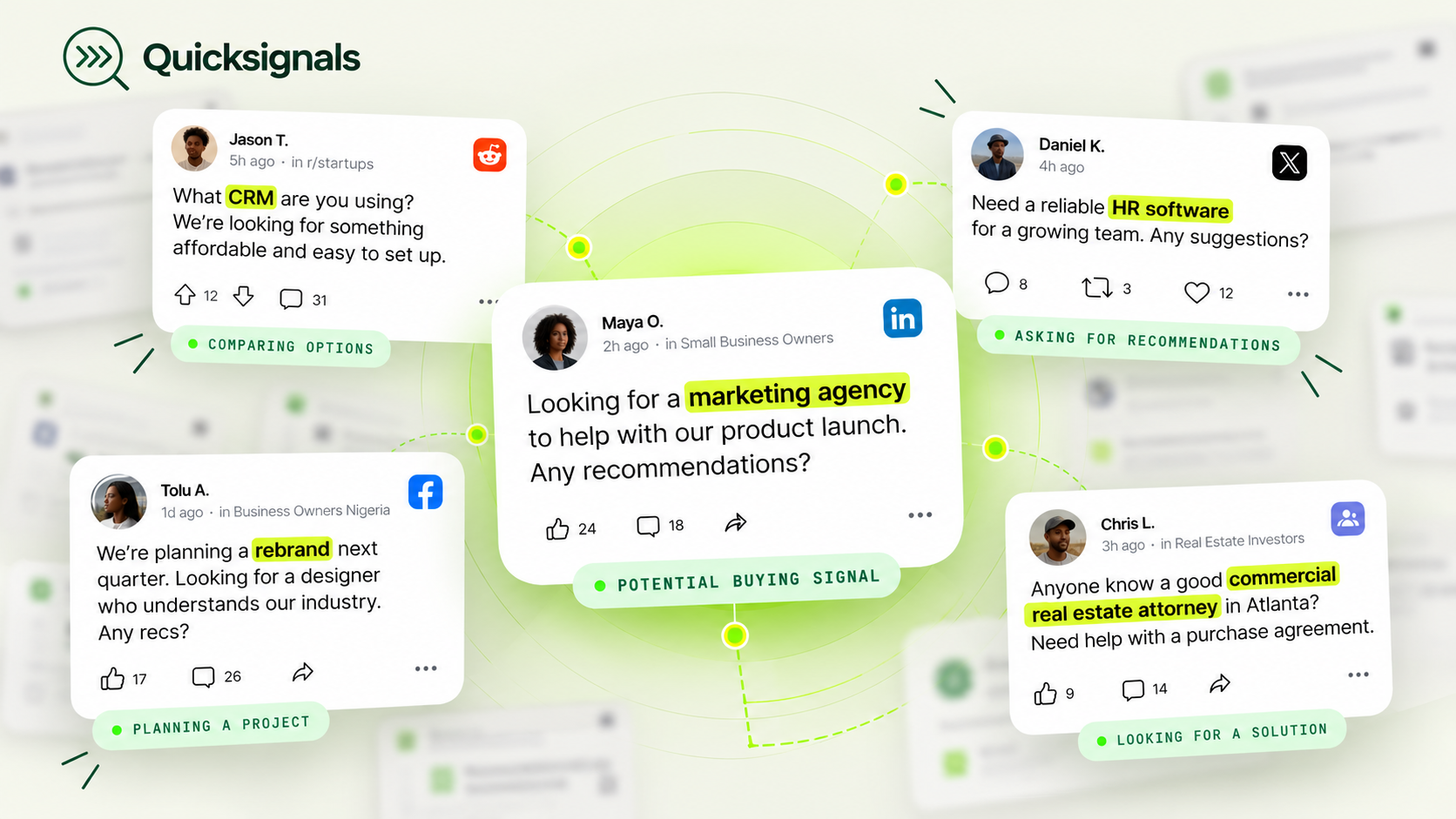
A potential client might post: “I’m looking for a designer to help us rebrand our business.” Or “We need a creative team for an upcoming product launch.”
These conversations are different from someone simply discussing branding or commenting on a marketing campaign.
They suggest that there is a specific need being explored.
For a creative agency, that distinction matters.
A conversation about design could be an opinion, a discussion, or an active search for a service. Understanding which one you’re looking at requires more than identifying a keyword.
Buying signals are generally behaviours or statements that suggest a prospect is considering a purchase or moving closer to a buying decision. Decoding Buying Signals in Sales HubSpot also explains that buying signals can help sales teams understand where a prospect may be in the decision process. blog.hubspot.com
The same principle can apply to creative services. The signal may not be a formal enquiry. It could be the moment a business starts publicly talking about a problem it needs to solve.
What Buying Signals Look Like for Creative Businesses
Buying signals for creative businesses can appear in several ways.
A business may ask for a recommendation for a branding agency. A founder may say they are looking for someone to redesign their website. A marketing manager may ask for content support ahead of a product launch. Someone may be comparing agencies, asking about pricing, or looking for a creative partner with a specific area of expertise.
Other signals may be less direct.
A company may mention that its visual identity no longer reflects where the business is going. A new product launch may create a need for campaign assets, social content, packaging, photography or design support. A growing business may start discussing the need for a stronger social media presence.
These conversations can indicate that a business is moving from simply talking about a challenge to exploring a possible solution.
But none of these conversations guarantees that a project will follow.
The person may still be researching, comparing options, gathering recommendations, or working with another provider. That is why the goal is not to label every relevant conversation as a lead.
The goal is to recognise when a conversation may indicate a real business need.
Look Beyond Words Like “Design” or “Marketing”
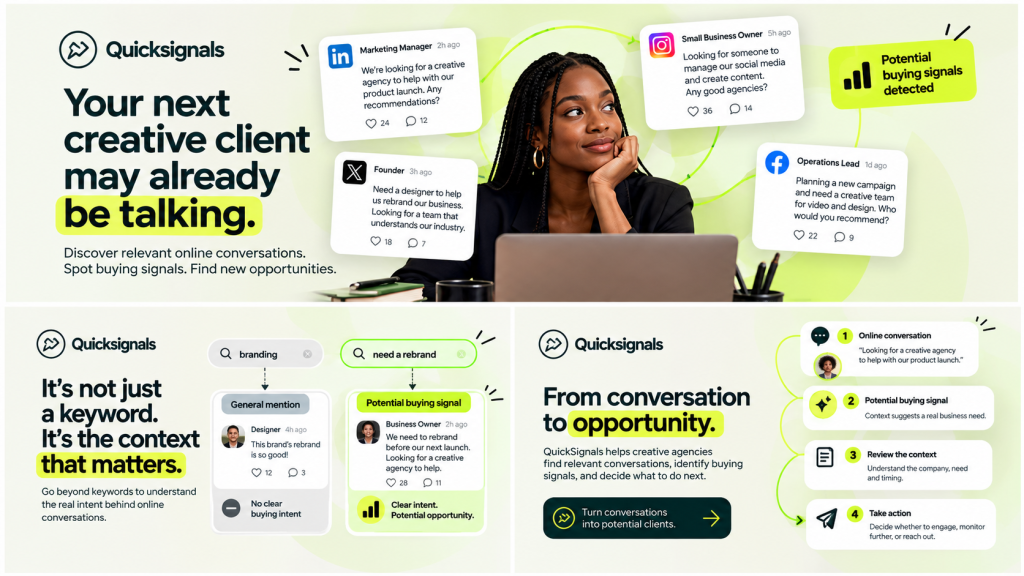
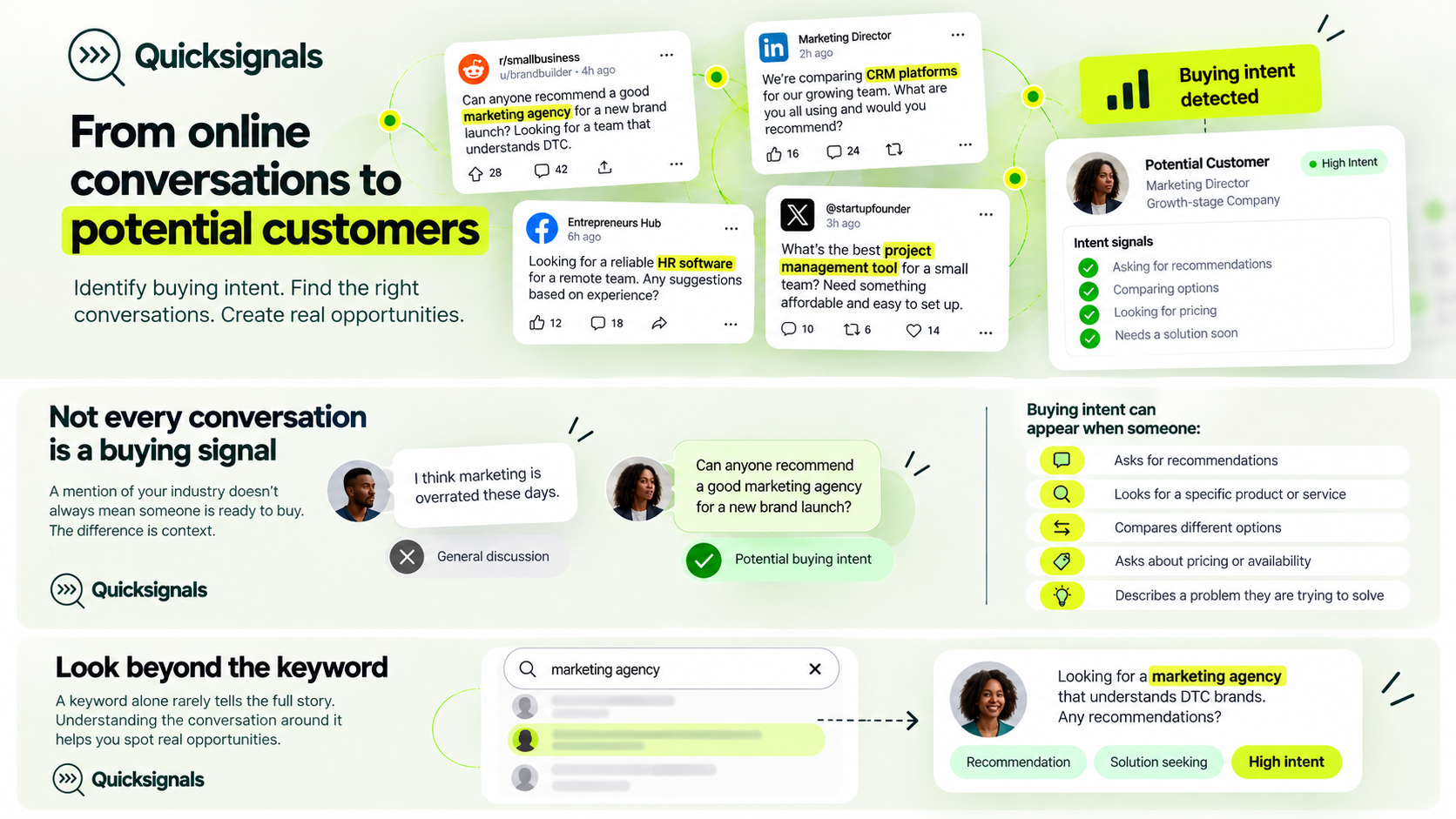
Someone mentioning “branding” may simply be talking about a campaign they like.
A keyword alone rarely tells the full story.
Someone saying, “We need to rebrand before our next launch,” is having a very different conversation.
That is why creative businesses need to look beyond individual words and understand the conversation surrounding them.
The useful question is not:
“Did someone mention design?”
It is:
“Is this person actually looking for design support?”
That difference can help an agency separate casual conversation from a situation that may be worth exploring.
This is where the idea of buyer intent becomes useful. HubSpot describes buyer intent as information that helps businesses understand a prospect’s readiness to buy, using signals such as research activity, company developments and other indicators of potential interest. Buyer Intent hubspot.com
For an agency, understanding that context can make it easier to decide which conversations deserve attention and which ones can be ignored.
How QuickSignals Helps Creative Agencies
This is where QuickSignals can become useful.
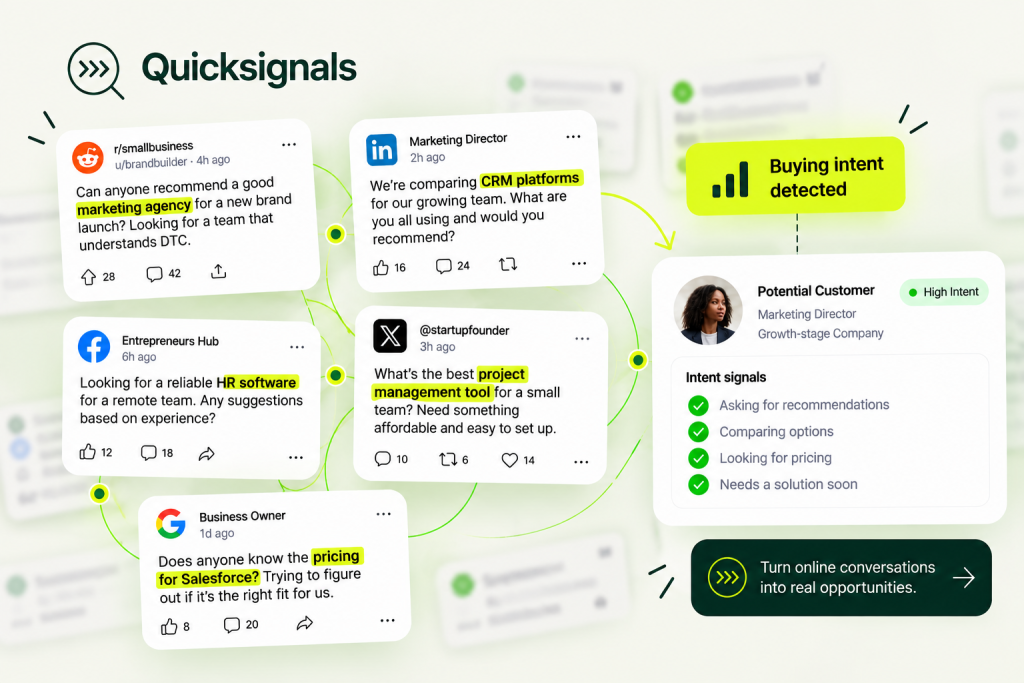
QuickSignals helps businesses discover relevant public conversations, review the context behind them, and identify potential buying signals.
For a creative agency, that could mean finding conversations around:
Branding
Design
Marketing
Content
Campaigns
Product launches
Instead of relying only on formal enquiries, referrals, or inbound briefs, agencies can use relevant conversations to gain another view of what potential clients are actively looking for.
The important part is the context.
A search for “branding agency” may return hundreds of conversations, but not all of them will be relevant.
One person may be sharing an article. Another may be asking for an agency recommendation. Someone else may simply be discussing a campaign from a brand they follow.
Those situations can look similar at the keyword level while meaning very different things.
QuickSignals is designed to help businesses find relevant public conversations and assess the potential signal behind them. The team can then decide which conversations may be worth exploring and what an appropriate next step could be.
That approach also connects to the broader idea of sales intelligence: using relevant signals and information to help teams identify and prioritise potential opportunities. Salesforce discusses buyer signals and other sales triggers as information that can help sales teams determine where to focus their attention. Sales Intelligence
The Opportunity Before the Brief
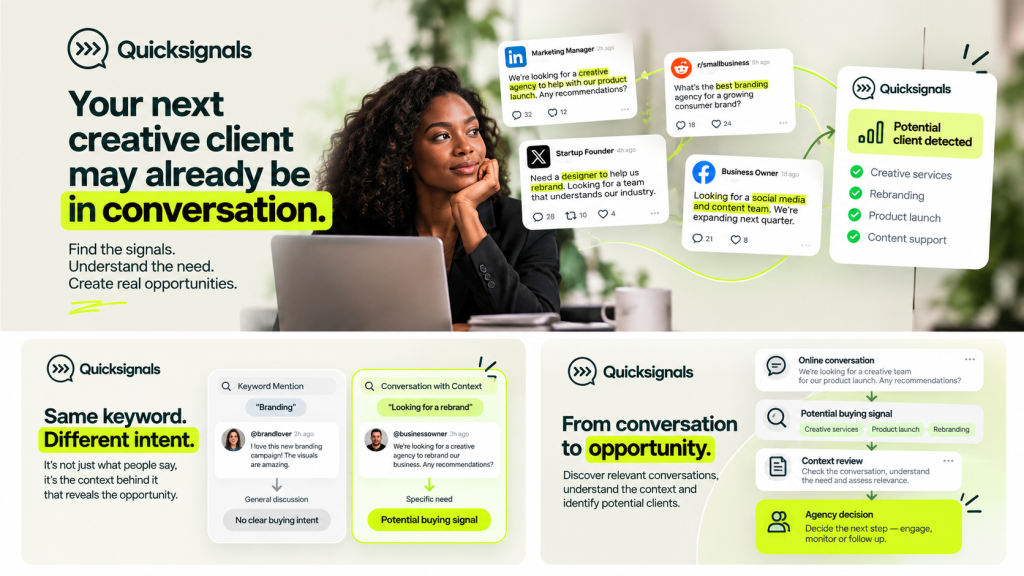
Creative agencies are accustomed to responding when the brief arrives.
But the conversation that eventually becomes a brief may start much earlier.
A business may first ask for recommendations.
It may mention an upcoming launch.
It may realise that its current brand no longer reflects the business.
Or it may simply start looking for someone who can solve a problem.
Those moments can provide useful insight into potential demand.
The opportunity is not to rush in with a sales pitch. A public conversation is not an invitation to force a sales message into someone’s feed.
Instead, it is an opportunity to understand what the person is trying to solve, assess whether the need is relevant to your business, and decide whether there is a sensible reason to engage.
For agencies, this can create another layer of visibility into the market.
Rather than seeing demand only after a prospect has submitted a form, sent an email, or requested a proposal, teams can pay attention to conversations that may signal a need earlier in the process.
Final Thoughts
Potential clients do not always announce themselves with a formal enquiry.
Sometimes, they start by asking a question.
Sometimes, they ask for a recommendation. Sometimes, they compare options. Sometimes, they simply describe a problem they are trying to solve.
For creative businesses and agencies, learning to recognise those conversations can provide another way to understand potential demand and identify opportunities worth exploring.
The goal is not to respond to every mention of your industry.
It is to understand which conversations have context, relevance and a potential need behind them.
The conversation may start before the brief does.
QuickSignals helps businesses discover relevant public conversations, understand the context behind potential buying signals, and decide what to do next.
Find the signal. Understand the need. Decide your next move.