Every business wants to reach potential customers at the right time. But what signals that someone may be ready to buy? The answer depends on the industry, the problem they need to solve, and how they begin looking for a solution.
A person searching for a new home will show different signs of intent from a company looking for recruitment support or a homeowner searching for a reliable plumber. Yet these situations share one important characteristic: people often reveal clues about what they need before they contact a business directly.
For businesses, recognising these clues can provide another way to understand customer demand and identify conversations that may be worth exploring.
What Are Buying Signals Across Industries?
Buying signals are actions, questions, statements, or changes in circumstances that suggest a person or business may be considering a purchase.
These signals can include asking for recommendations, comparing providers, enquiring about prices, discussing a specific challenge, or announcing a business development that could create a need for a product or service.
According to HubSpot’s guide to buying signals, signals can appear in online interactions and in changes affecting a potential customer’s business. Salesforce also explains how events such as hiring, expansion, and new funding can create opportunities for relevant conversations (Salesforce: What Is Sales Intelligence?).
However, a signal is not proof that someone will buy. It is an indication of possible interest that needs to be understood in context.
How Buying Signals Differ Across Industries

Although the underlying principle is similar, the conversations and activities that indicate potential demand vary across markets.
1. Recruitment: Signs That a Business May Need Talent
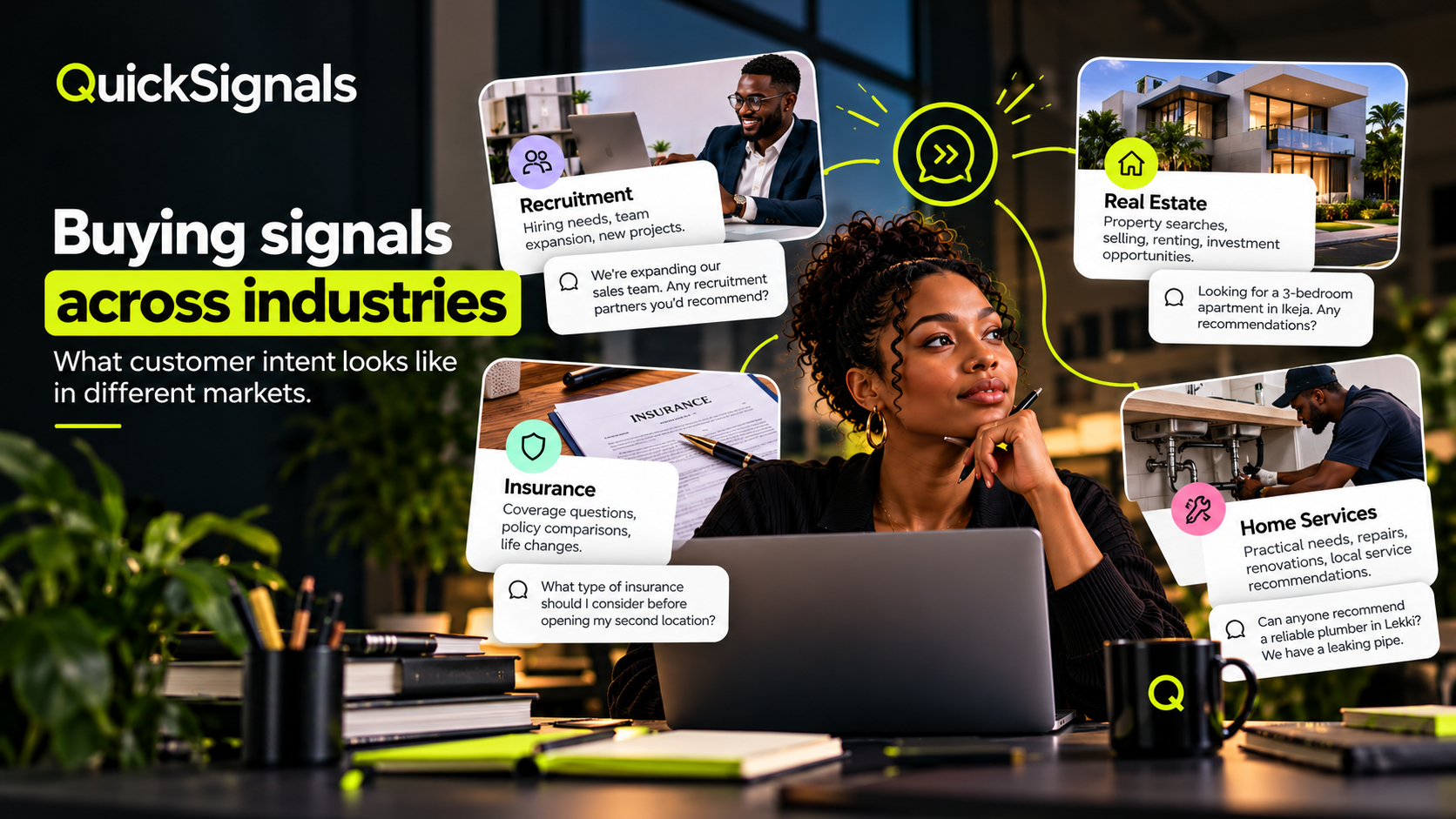
For recruitment agencies, potential buying signals can emerge when businesses discuss expansion, announce new projects, or begin hiring across several roles.
For example, a company might post:
“We’re expanding our sales team and looking for experienced professionals. Any recommendations for a recruitment partner?”
This is a relatively direct signal because the business has expressed a hiring need and is seeking support.
Other potential signals include repeated job advertisements, announcements about entering a new market, and public discussions about building a new team.
These developments do not automatically mean a company intends to hire an agency. They can, however, give recruiters a reason to investigate further and determine whether their services are relevant.
2. Real Estate: Signs That Someone Is Looking to Buy, Sell, or Rent
In real estate, buying signals may appear when people begin discussing specific property requirements, asking for agent recommendations, or exploring available properties in a particular location.
For example:
“I’m looking for a three-bedroom apartment in Ikeja. Which areas would you recommend?”
A property owner might also ask about selling a home, while a business owner could enquire about commercial space for a new location.
These conversations can help real estate professionals understand what prospective buyers, tenants, landlords, or investors are looking for.
The context matters. Someone discussing property prices out of curiosity is not necessarily preparing to transact. Someone describing a location, budget, and specific property requirements may be expressing a more concrete need.
3. Insurance: Signs That Someone Needs Cover or Advice
Insurance-related intent may appear when individuals or businesses ask about suitable coverage, compare policy options, or seek recommendations after a change in their circumstances.
A small business owner, for example, might ask:
“What type of insurance should I consider before opening my second location?”
A family might ask for recommendations for life insurance, while a business could be researching cover for new equipment or employees.
For insurers and brokers, these conversations can highlight questions worth addressing and potential needs that may warrant further discussion.
However, insurance decisions are personal and often involve eligibility, affordability, exclusions, and individual circumstances. A public question should be treated as an invitation to understand the need, not an assumption that the person is ready to purchase a policy.
4. Home Services: Signs That Someone Needs a Practical Solution
For home service providers, buying signals are often direct and problem-focused.
Someone might post:
“Can anyone recommend a reliable plumber in Lekki? We’ve been dealing with a leaking pipe.”
Another person may be looking for an electrician, a cleaning service, a painter, or a contractor to renovate a property.
These conversations can reveal a specific problem, a need for a professional, and sometimes a preferred location or timeframe.
For local service businesses, recognising relevant requests can help them identify conversations that align with the services they offer. The important next step is to assess whether the request is current, relevant, and appropriate to respond to.
Why Context Matters More Than Keywords
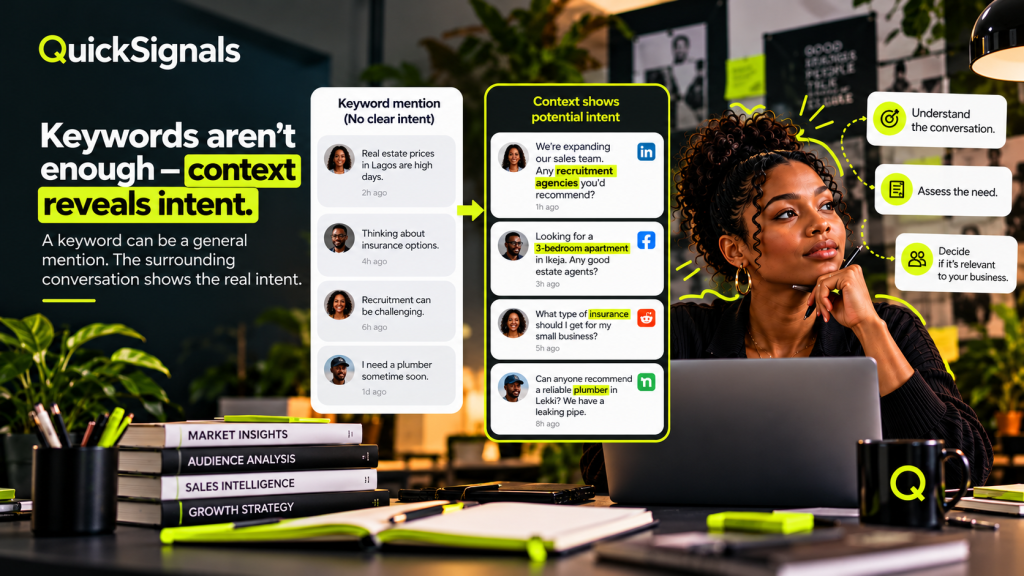
Across all four industries, one thing remains consistent: a keyword alone does not establish buying intent.
Someone mentioning recruitment may be discussing a career change rather than looking for a recruitment agency. A person talking about insurance may be sharing news rather than seeking a policy. A property discussion may have nothing to do with an active purchase.
The difference lies in the surrounding conversation.
Is the person asking for recommendations? Have they described a problem? Are they comparing providers or asking about pricing? Do they appear to be exploring a specific solution?
Understanding these details helps businesses distinguish general discussion from a potential opportunity.
It also helps teams avoid treating every mention as a lead or approaching people with irrelevant sales messages.
How QuickSignals Helps Businesses Identify Potential Buying Signals
Finding relevant conversations manually can be difficult when discussions are spread across different public online platforms.
QuickSignals helps businesses discover relevant public conversations, review the context behind them, and identify potential buying signals.
This can be useful across different markets because the topics businesses monitor can reflect the needs they are equipped to address.
A recruitment agency might focus on conversations about hiring support. A real estate business might monitor property enquiries. An insurance provider might look for questions about coverage, while a home services company might focus on requests for local recommendations.
The objective is not to assume that every conversation will become a sale. It is to help teams identify relevant discussions, understand what people may need, and decide which opportunities are worth exploring.
Learn more about QuickSignals.
Final Thoughts
Buying signals do not look the same in every industry, but they serve a similar purpose: they can reveal what people and businesses may be looking for before a formal enquiry arrives.
For recruitment, the signal might be a growing need for talent. For real estate, it could be a request for property recommendations. For insurance, it may be a question about coverage. For home services, it could be a request for help solving a practical problem.
Recognising these differences allows businesses to approach potential customers with greater context and relevance.
The opportunity is not simply to find more conversations. It is to understand which conversations may matter to your business.
Find the signal. Understand the need. Decide your next move.